Blog
The debate around machine translation vs AI translation is getting louder every year. With the rapid rise of AI in translation, it sometimes feels like the industry is standing at a crossroads. Is traditional machine translation becoming outdated? Is generative AI the new standard? And more importantly, are human linguists still essential?
Scripted by
TuongVi Vo

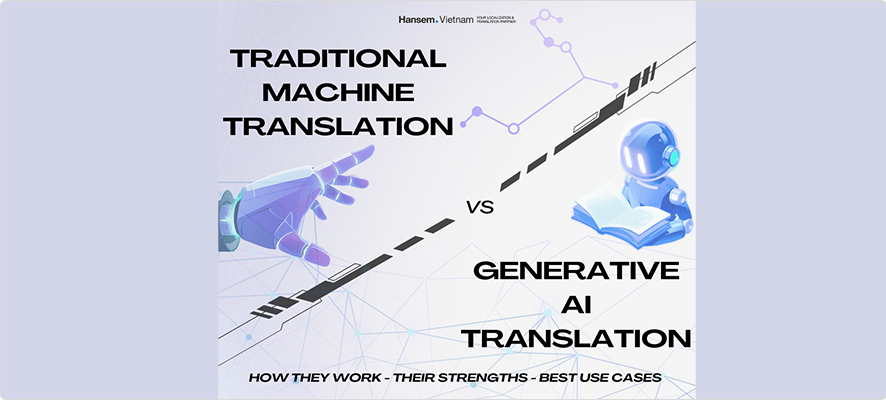
The answer is not as dramatic as people think. This is not a battle where one tool replaces the other. The real question is much more practical: how can linguists use both technologies intelligently to work faster, deliver better quality, and stay competitive in a rapidly evolving landscape?
When discussing machine translation (MT), most people think of tools like Google Translate or DeepL. And honestly, that’s fair. These tools are everywhere. But machine translation has come a long way. It started with rigid rule-based systems, moved into statistical models, and today largely runs on neural machine translation.
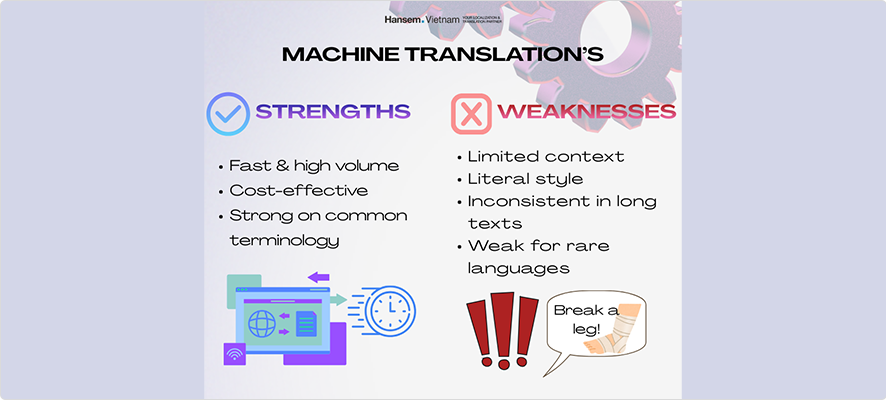
Modern MT is impressively fast. Give it a 200-page technical manual, and it will process everything in seconds. It performs especially well with repetitive, structured content like software strings, user guides, product descriptions, and standard business documents. For high-volume projects, this speed and efficiency make MT extremely practical.
Unfortunately, machine translation is not excellent at understanding meaning. MT predicts what words usually go together. It does not actually understand who is speaking, why they are speaking, or how they want to sound. That difference becomes obvious when language moves beyond simple instructions.
Additionally, MT struggles with Rare Languages. MT needs massive data to learn. So, for languages with less content on the internet, like Lao, Burmese, or pairs like Burmese-Japanese, it often fails because it simply hasn’t seen enough examples to learn the patterns.
These are not rare edge cases. They happen whenever tone, culture, humor, or emotion enter the picture. MT handles structure well, but nuance is a different story. And this is exactly where the conversation shifts. If machine translation struggles with context and intent, can newer forms of AI in translation do better?
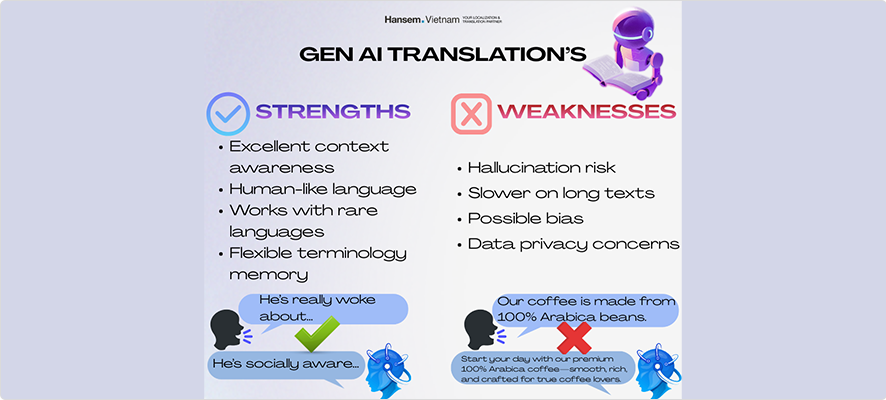
When people talk about “AI translation” today, they are usually referring to generative AI models being used for translation tasks. Unlike traditional MT systems that focus mainly on predicting equivalent words and phrases, generative AI models are trained on a much broader range of content, including books, articles, code, conversations, and technical materials. In other words, it does not just learn how sentences align. It absorbs writing styles, world knowledge, reasoning patterns, and relationships between languages.
This broader training enables something called zero-shot translation. That means the model can translate language pairs it has rarely seen directly, because it transfers knowledge across languages. This becomes especially powerful when dealing with idioms, slang, or cultural expressions. Instead of translating word by word, AI attempts to interpret meaning.
Generative AI is also a game-changer for low-resource languages. Traditional MT depends heavily on large volumes of bilingual data. If a language pair lacks enough examples, performance drops. Generative AI, however, can leverage similarities between related languages.
However, generative AI is not without risk. One of the most serious concerns is hallucination. When the model is uncertain, it may generate information that was never present in the source text.
Bias is another issue. Since these systems learn from large volumes of online data, they may reflect stereotypes embedded in that data. Data privacy is also a concern when sensitive content is processed through cloud-based systems. And that leads to the next important question: if both MT and AI have strengths and weaknesses, how should linguists actually use them in practice?
So, instead of debating machine translation vs AI translation, let’s talk about what actually happens in a linguist’s daily workflow. Because in reality, the decision is rarely theoretical. It is situational.
| When to Use Machine Translation | When to Use Generative AI |
|---|---|
| 1. Use MT for real-time understanding: Imagine you are in a live online meeting and someone drops a message in another language in the chat. Or you receive a quick internal email from a regional office that you need to understand immediately. In those moments, you are not polishing style. You just need the meaning, fast. MT is perfect for that. It gives you instant comprehension, and that is often enough. | 1. Use AI for creative or persuasive content: If you are translating marketing copy, social media posts, app store descriptions, or promotional emails, tone matters as much as meaning. Generative AI can help reshape the text so it feels more engaging and aligned with the brand voice. |
| 2. Use MT for repetitive technical content: If you are working on IT documentation, user manuals, UI strings, compliance checklists, or product specifications, MT performs extremely well. These types of documents contain repeated terminology and predictable sentence structures. The machine does not get tired of translating “Click the Settings button” for the hundredth time. In these cases, MT provides a solid draft quickly, and you step in for MT post-editing to ensure terminology consistency and clarity. | 2. Use AI when the target audience matters: Sometimes the task is not just “translate this”. but “translate this for a 12-year-old”, or “translate this for medical professionals”, Generative AI can adjust vocabulary complexity and tone accordingly. That level of audience adaptation is difficult for traditional MT systems to handle. |
| 3. Use MT when you need controlled privacy with an offline system: If your company has an on-premise or offline MT engine and you are handling confidential legal or financial content, this can be a safer option than uploading documents to a public AI tool. In this case, MT supports productivity without compromising data security. | 3. Use AI when nuance is critical: If you are working on speeches, thought leadership articles, emotionally driven narratives, or complex language pairs, context and subtle meaning become essential. Generative AI often produces output that feels more natural and less mechanical because it considers broader context. |
However, whatever tools used, human review remains mandatory. AI can enhance fluency, but it can also introduce small shifts in meaning. Your role is to ensure nothing important has changed.
With all the progress in AI in translation, it is easy to feel that technology is taking over. The tools are faster. The output sounds more natural. The interfaces are smarter than ever. But here is the reality: no tool takes responsibility.
Only professional linguists can truly interpret cultural expression, protect brand voice, evaluate legal implications, and make judgment calls when the source text is ambiguous. When a sentence could mean two different things, the machine picks one. A human stops and asks, “Which one is correct in this context?” That pause, that decision-making process, is something automation cannot replicate.
This is why many linguists today are not rejecting technology. They are mastering it. Following current translation technology trends, professionals are designing workflows that combine speed with judgment. A common workflow looks like this:
In this evolving landscape, linguists are no longer just translators of words. They are language experts, quality controllers, and decision-makers. AI may change how the work is done, but it does not eliminate the need for expertise. It reshapes the role into something more strategic and higher value.
The discussion around machine translation vs AI translation should not be framed as a competition. MT and AI are tools. They serve different purposes. When used correctly, they complement each other. Linguists who understand both technologies can work faster without sacrificing quality. They can take on more complex projects, manage higher volumes, and deliver greater value to clients. The future of AI in translation is not about replacement. It is about collaboration between technology and human expertise.
If you are interested in applying these workflows in real projects, feel free to join Hansem Vietnam’s linguist pool and collaborate on translation, MT post-editing, and AI-assisted language projects across multiple domains. Whether you already have experience with MTPE or are just beginning to explore AI-driven workflows, there’s room for you to grow with us.
Simply send your CV to cs_hsvn@hansem.com, and our team will review your profile and get in touch if there’s a suitable opportunity.
Hansem Global is an ISO Certified and globally recognized language service provider. Since 1990, Hansem Global has been a leading language service company in Asia and helping the world’s top companies to excel in the global marketplace. Thanks to the local production centers in Asia along with a solid global language network, Hansem Global offers a full list of major languages in the world. Contact us for your language needs!