


2026.11.20
ChatGPT, Claude, Gemini—today’s large language models (LLMs) show impressive translation performance. But anyone who has tried using these models on real business documents tends to encounter the same issue: everyday sentences may look excellent, but quality becomes unstable as soon as industry-specific terminology appears.
2026.11.20
Expectations around AI translation are running high, and for good reason. But once you start running real projects in production, a more nuanced picture emerges: AI translation transforms some workflows dramatically — and complicates others.
2026.11.13
Interest in AI translation is rising quickly. Many companies are drawn to the promise that AI can make translation faster and less expensive, while at the same time worrying that quality may not be reliable enough. Even when interest is high, many business teams still do not know where to begin or what to evaluate first.
2026.11.13
More companies are adopting AI translation. Yet when the same document is given to multiple translation providers, the difference in output quality is often greater than expected. If everyone says they use AI translation, why are the results so different?

2026.11.06
The pharmaceuticals, biotechnology, and healthcare industries in Korea hold significant growth potential in the global market. Many companies are expanding into international markets, leveraging Korea’s capabilities in biopharmaceutical research and development. However, effective communication strategies and precise translations are essential for success. Particularly in the pharmaceuticals, biotechnology, and healthcare sectors, where specialized documents are abundant and regulations are complex, accurate and effective translation is crucial.
2026.11.06
In the complex landscape of medical devices, ensuring clear and accurate communication is not just a matter of convenience; it’s a critical component of patient safety and regulatory compliance. “Instructions for Use” (IFU) serve as the cornerstone of guidance for healthcare professionals and patients navigating the intricacies of device operation and maintenance. However, translating IFU presents formidable challenges, demanding meticulous attention to detail and precision to avoid potentially dire consequences. In this comprehensive exploration, we delve into the indispensable role of the back translation process in upholding the integrity and accuracy of translated IFU for medical devices.
2026.10.30
For a medical device, the manual itself can hold up market entry. In regulatory terms the user manual is the IFU (Instructions for Use) – a core document tied directly to product clearance, labeling, and usability evaluation, and one of the most common reasons an FDA 510(k) submission stalls. This second installment of our Manuals Under Regulatory Scrutiny series maps the IFU and labeling requirements that medical device manufacturers most often run into when pursuing FDA 510(k), Health Canada, and MDSAP, and explains why regulatory strategy and document production must be managed together.
2026.10.30
A Practical Guide to Preparing Instructions for Use (IFU) for U.S. Medical Device Marketing Authorization
2026.10.23
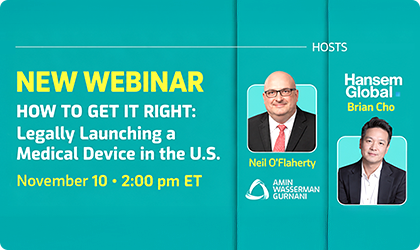
The U.S. remains one of the most competitive and tightly regulated markets for medical devices. But even with a high-quality product, many companies face costly delays—not because of flaws in technology, but due to gaps in documentation or misunderstanding of regulatory requirements.
2026.10.23
Hansem Global is co-hosting a webinar with Amin Wasserman Gurnani (AWG), a U.S.-based FDA regulatory law firm, on what it takes to bring a medical device to the U.S. market. “How to Get It Right: Legally Launching a Medical Device in the U.S.” brings legal…
